

Type “knaw” into a search bar and pause before hitting Enter, and you’ve probably already landed on the real question: Knaw or Gnaw, which one actually belongs on the page? The answer is gnaw. Knaw isn’t excluded by some arbitrary rule — it’s excluded because English stopped pronouncing that leading g centuries ago and never bothered to update the spelling. The word sounds like “naw,” but it’s still written with a silent letter up front, and that gap between sound and spelling is the entire source of the confusion.
A dog gnaws a bone. A worry gnaws at you the night before a big presentation. Swap in a k anywhere in either sentence, and it stops looking like English.
Why your ear leads you astray
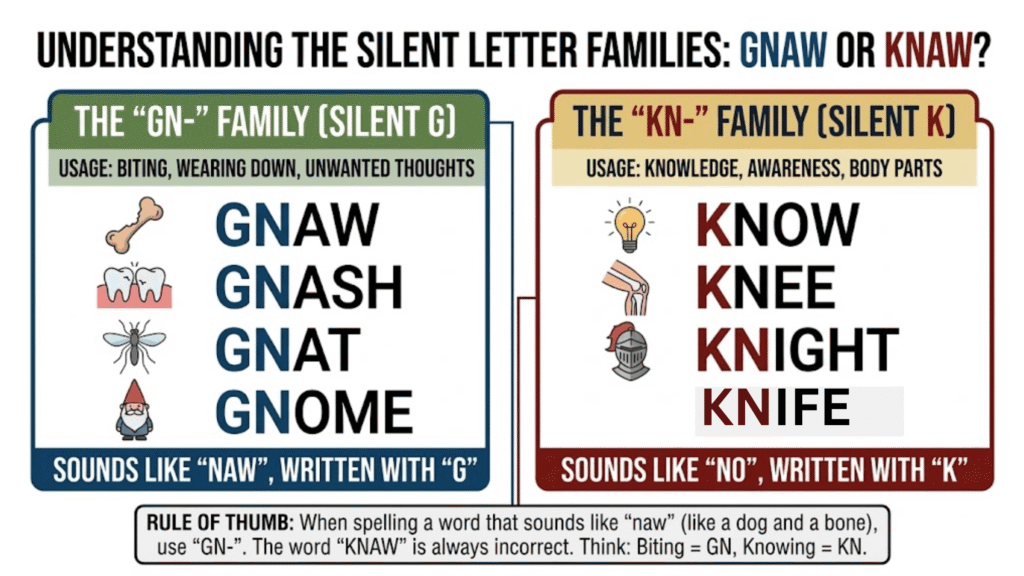
Say the word out loud, and there’s no g sound anywhere — just “naw.” Faced with that gap, most writers default to whatever spelling pattern feels familiar, and English has trained people well on one particular pattern: silent letters before an n, as in know, knee, knife, knight. So “knaw” isn’t a random guess. It’s a reasonable one, borrowed from the wrong word family.
That’s the actual mechanism, and it’s worth naming because it explains a whole category of English spelling mistakes, not just this one. Someone who mishears the middle of “important” and writes “inportant” is making the same kind of error — letting sound stand in for spelling and getting burned by a language that doesn’t always cooperate. It’s the same instinct behind writing continous instead of continuous, where an unstressed syllable just gets swallowed and dropped. Gnaw is one of the clearer examples, though, because the mismatch between how it’s said and how it’s written is so total.
What gnaw covers actually
Gnaw earns its keep across three fairly distinct uses, and separating them makes the word easier to place correctly.
The most obvious use is literal chewing — teeth working steadily at something that resists. Picture a puppy that’s found the leg of a kitchen chair, or a squirrel wearing a hole through the plastic housing of a bird feeder to get at the seed inside. This sense isn’t gentle. It implies effort and repetition, something that takes real time to wear down.
A second use drops the teeth entirely but keeps the same slow, cumulative damage. Saltwater gnaws at a dock’s wooden pilings over the course of a decade. A slow pipe leak can gnaw away at drywall for months before anyone spots the stain. Nothing here is biting anything, yet the word still fits, because the underlying idea — steady erosion rather than a single blow — is what gnaw is actually built around.
The third use, and probably the one that shows up most in everyday writing, is emotional: a feeling that won’t leave you alone. A missed deadline gnaws at you for days. An unresolved disagreement with a friend gnaws at your attention right when you’re supposed to be focused on something else entirely. This sense almost always shows up as “gnaw at,” not gnaw on its own — a small pairing worth remembering if you want the sentence to sound like something a person would actually say.
Where “knaw” actually comes from
Most explanations of this word treat “knaw” as a typo with no backstory. It’s more interesting than that.
In older English — Scots texts from roughly the 1400s through the 1600s, specifically — “knaw” appears as a dialect spelling of “know,” with no connection to chewing or biting. A line like “dudn’t ee knaw” simply means “don’t you know.” That’s thread one.
Thread two is stranger. Records from that same period and dialect also use “knaw” as a genuine variant spelling of gnaw — the biting word. One 15th-century Scots source describes dogs gnawing bones and spells it with a k. So for a stretch of a few hundred years, one unusual spelling covered two completely unrelated words at once, and which meaning you got depended entirely on context.
None of that makes “knaw” acceptable today — spelling was standardized precisely so readers wouldn’t have to guess which of two meanings a writer intended. But it does explain why the spelling doesn’t feel like nonsense when it crosses your mind. At one point in English’s history, it genuinely wasn’t.
See Also: Quit vs Resign: What Is the Difference?
The silent-letter family gnaw belongs to
Once the silent g clicks for gnaw, a handful of related words stop looking like isolated exceptions and start looking like one pattern.
Gnat, the small flying insect, follows the same rule. So does gnome, and so does gnash, as in gnashing your teeth. All four open with a g that does nothing for the pronunciation. Learn one, and the others tend to fall into place, because your brain starts recognizing “gn-” at the front of a word as a single signal rather than four separate spelling quirks to memorize.
That’s a different family entirely from words like know, knee, and knife, where the silent letter is k rather than g. Both patterns get blamed for the same confusion, but they trace back to separate roots in the language, and it helps to keep them mentally apart. One rough shortcut: words about biting, teeth, or wearing something down tend to sit in the gn- camp; words about awareness or body parts tend to sit in the kn- camp. It’s not airtight, but it holds up often enough to remember.
A fast way to check yourself
Mid-sentence, swap the word out for something with a similar meaning — chew, bite, wear away, bother. If the sentence still reads fine with the substitute, you’re squarely in gnaw territory. There’s no situation where that test points toward knaw, because knaw doesn’t carry any of those meanings in current English.
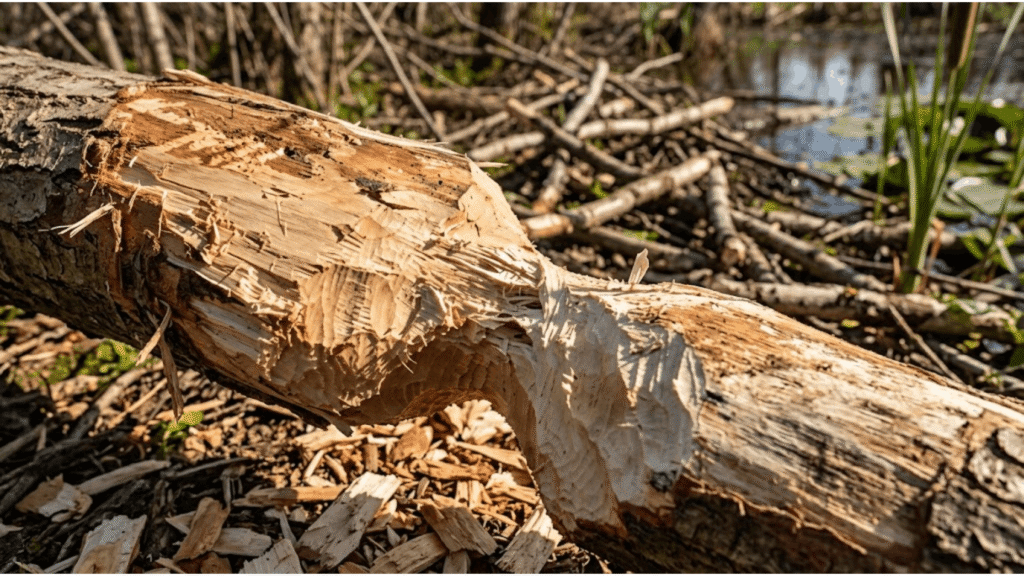
A text that reads “the dog has been knawing that toy for an hour” needs the g back. An email line like “this issue keeps knawing at the team” needs the same fix. A caption under a photo of a beaver-chewed log — “nature’s knawed through half this tree” — loses the k the same way. These aren’t complicated corrections once you catch them; they’re just easy to miss in a first draft, roughly the way someone typing fast might write the 22th instead of the 22nd and not notice until a second read.
The forms you’ll actually use
Gnaw conjugates the ordinary way, which is one less thing to think about once the base spelling is settled.
- Gnaw (base form): “Rabbits gnaw on wood to keep their teeth from overgrowing.”
- Gnaws (present, third person): “That old anxiety still gnaws at him every time he flies.”
- Gnawing (present participle): “She had a gnawing sense that she’d left the stove on.”
- Gnawed (past tense): “By morning, the mice had gnawed clean through the cardboard box.”
The figurative and literal senses sit side by side comfortably here, and that’s not an accident — both are built on the same idea of slow, persistent action, just aimed at different targets. Getting that pattern down is a bit like building repore with a new coworker instead of rapport — the details might feel awkward at first, but they lock into place with a little repetition.
A few close cousins worth knowing
Gnaw has some neighbors that are easy to mix up with it.
Gnash means something else entirely — grinding your teeth together, usually out of frustration or anger, with nothing external being bitten. “He gnashed his teeth when the flight got delayed again” describes a reaction, not an act of chewing.
Nibble sits at the gentler end of the same general idea. A mouse nibbles at cheese in small, careful bites; gnawing implies more force and more persistence, something that takes real effort to get through.
And then there’s “naw,” sometimes spelled “nah” — an entirely unrelated, informal way of saying no. It sounds almost identical to gnaw, which is exactly why the two end up typed into the same sentence by accident more often than you’d expect, especially in fast, casual writing where nobody’s proofreading closely.
Settle the silent g in your head once, and this whole cluster of near-misses stops being a guessing game. Next time you watch a dog work through a rawhide chew for the better part of an afternoon, you’ll know exactly which word describes it — and exactly why the k never belonged there in the first place.

[…] See Also: Knaw or Gnaw — Which One Is Actually Correct? […]