

If you’ve ever paused mid-sentence wondering whether you meant propose or purpose, you’re not imagining the resemblance — there really is one. These two words aren’t just similar by coincidence; they’re the same word wearing two different outfits. One’s a verb, one’s a noun, and once you see how they split apart centuries ago, mixing them up gets a lot harder to do.
Here’s the short version. Purpose is a noun. It’s the reason behind something — why a document exists, why you’re in a meeting, why a tool was built the way it was. Propose is a verb. It’s the act of putting an idea in front of someone else for them to weigh in on. A grant application has a purpose. A committee proposes a budget.
Purpose: the noun that answers “why”
When you use purpose, you’re naming a reason or an aim. It’s what something is for.
Say a nonprofit is drafting a mission statement. The purpose section isn’t describing what they’re doing next Tuesday — it’s answering why the organization exists at all. Or picture a product manager explaining a new feature to stakeholders: “The purpose of this dashboard is to cut the time it takes support staff to find a customer’s order history.” That’s the purpose at work—showing why something was created in the first place
It shows up constantly in set phrases, too. Someone leaves a typo in on purpose to see if anyone actually reads their emails. A policy gets written to close a loophole. Two departments end up working at cross-purposes when nobody bothered to sync their goals. In every one of these, purpose is standing in as a thing — an idea you can name, point to, or argue about.
See Also: Continuous vs Continous: 3 Tricks to Get It Right
Propose: the verb that puts something forward.
Propose works completely differently. It’s an action — offering something up, usually for someone else to accept, reject, or debate.
A city council member proposes rezoning a lot for affordable housing. An engineer proposes swapping out a vendor because the current one keeps missing shipping deadlines. Someone kneels down and asks someone to marry them. In each case, propose marks the moment something gets put on the table — not the reason behind it, just the act of suggesting it.
Grammar trips people up more than meaning does. Propose can take a noun directly (“She proposed a new schedule”), a gerund (“He proposed moving the launch date”), a that-clause (“The board proposed that the fee be waived”), or a to-infinitive when it means intend rather than suggest (“They propose to open a second location next year”). The mistake people actually make is treating a person as the direct object of the idea itself—writing something like “The manager proposed him to run the pilot program,” when the sentence needs “The manager proposed that he run the pilot program.” Whatever gets proposed has to be an idea or an action. A person can’t be the thing proposed — only the one doing the proposing, or the one named in the clause.
Why these two look like siblings — because they are
This is the part most explanations skip, and it’s the actual reason the confusion exists in the first place: purpose and propose come from the same Latin verb, split into two English words centuries apart.
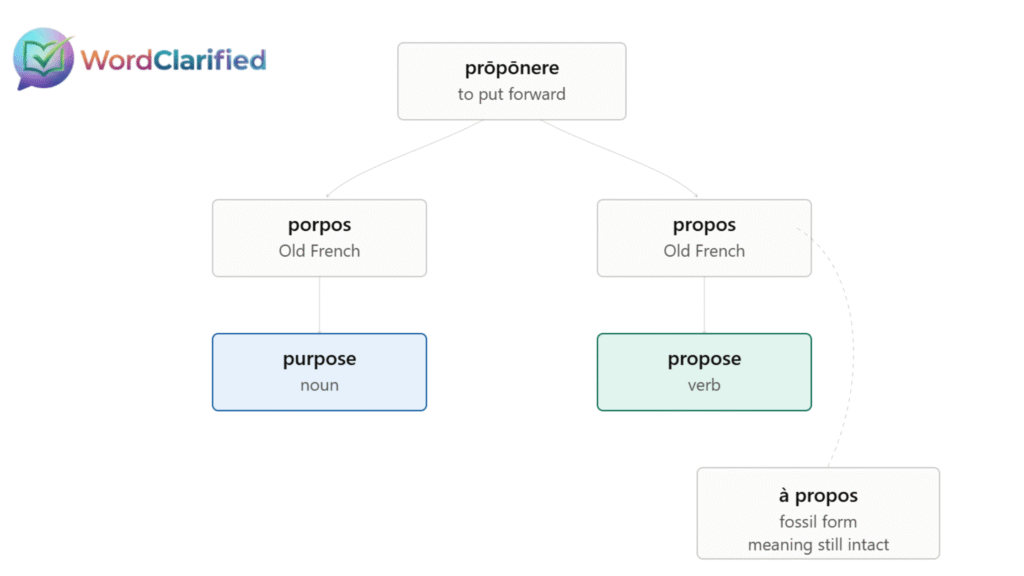
The source is prōpōnere — a Latin compound built from a prefix meaning “forward” and a root meaning “to put” or “place,” so the underlying idea is something set down in front of you for consideration. That word made its way into Old French, where it eventually forked into two spellings. One branch held onto an older vowel pattern and came into English as the noun purpose. The other followed a later shift in French pronunciation and arrived as the verb propose. Same root, two separate paths into English, and both survived.
One leftover from before the split is still hiding in plain sight: the phrase à propos, borrowed directly from French, where propos still carries the original, un-forked meaning — something put forward, relevant to the matter at hand.
The twist almost nobody mentions: purpose used to be a verb
Here’s where it gets genuinely strange. Purpose wasn’t always confined to noun duty. In Middle English, it also worked as a verb — and it meant close to what propose means today: to intend something, or to put it forward for others to weigh. B.F. Skinner picked up on this in About Behaviorism, pointing out that English speakers once used “purpose” the way we now reach for “propose,” before the two words drifted into their current, separate lanes.
Eventually propose absorbed that job entirely, and purpose settled into being purely a noun — the reason, not the act of raising it. So the overlap you sense between these two words isn’t a coincidence or a modern mix-up. For a stretch of English history, they really were doing the same work.
Side by side
| Purpose | Propose | |
| Part of speech | Noun (occasionally a rare, dated verb) | Verb |
| What it does | Names a reason or intention | Puts an idea forward for consideration |
| Typical sentence slot | Subject or object: “the purpose of…” | Main verb: “she proposes…” |
| Common phrases | on purpose, for, serve a purpose, cross-purposes | propose a toast, propose marriage, propose that, put forward a proposal |
| Quick test | Can you swap in “reason” or “aim”? | Can you swap in “suggest” or “put forward”? |
A way to keep them straight for good
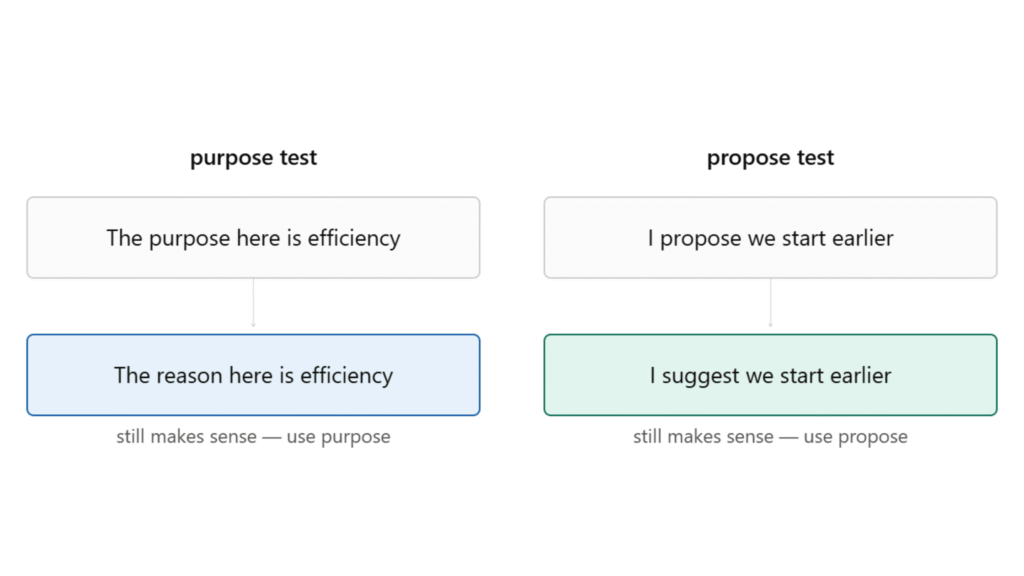
Skip the memorization and go by sentence position instead. Purpose sits where a noun sits — after “the,” after “a,” as the subject or object. Propose sits where a verb sits — right after the subject, doing the action. Try the substitution test: if “reason” fits in its place, you want purpose. If “suggest” fits, you want propose.
Next time you hesitate over which one to type, that’s usually enough to settle it in about two seconds — no lookup required.
See Also: Knaw or Gnaw — Which One Is Actually Correct?

[…] See Also: Propose vs Purpose: The Word History Nobody Tells You […]