

You’re scrolling through TikTok, and someone’s caption reads “CBFW szn.” A few videos later, a friend texts you the same four letters, except this time the vibe feels completely off from what you just saw. That gap is the real story behind CBFW meaning in text — it’s not one fixed definition; it’s a term that splits into two almost opposite moods depending on who’s typing it and where.
The short answer: CBFW most commonly stands for “Can’t Be F***ed With,” a phrase used to project confidence, an unbothered attitude, or a sense that nothing and no one can knock someone off their game. But there’s a second, quieter meaning floating around too — one that lands almost the opposite way. Mixing the two up is easy, and it’s exactly why people end up typing “CBFW meaning” into a search bar mid-conversation.
Two Meanings, One Acronym
The profanity buried in the middle of the acronym does most of the work here, and it’s also why the meaning splits. Spelled out in full, CBFW reads as a flex — someone declaring they’re operating on a level where criticism doesn’t register. Post “she’s CBFW rn” under a friend’s promotion announcement, and you’re handing out a compliment, not a jab.
Change what that middle letter stands for, though, and the whole thing tips over into something else entirely. A good portion of everyday use softens CBFW into “Can’t Be Bothered With,” which drops the swagger and replaces it with plain exhaustion. Text a friend “I’m CBFW today, not answering anyone,” and that’s someone checked out for the day, not someone flexing.
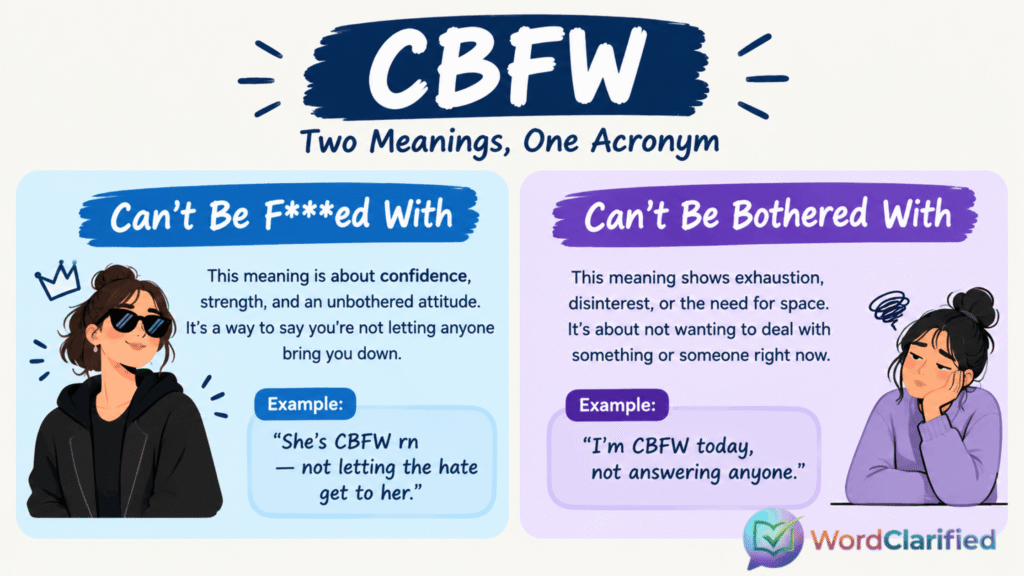
Part of the split comes down to censorship habits — people avoid spelling out the actual word and land on whichever replacement fits the letter, and “bothered” versus the uncensored original carry genuinely different weight. The rest is just ordinary slang drift: enough people repeat a term without tracing its roots, and it starts meaning different things in different mouths. Nothing in the four letters themselves flags which version you’re getting — that job falls entirely on whatever surrounds them.
Where CBFW Came From
There’s no clean origin story here, and any source that hands you a tidy timeline is probably filling in gaps with guesswork. What’s traceable is momentum: CBFW picked up serious steam through TikTok, where confidence-coded phrases travel fast through captions, comment threads, and text overlays.
The raw material existed before that, though, in a different shape. “Can’t be f***ed” has been slang for reluctance on its own for a long time, well before CBFW showed up as its own phrase. Somewhere along the line, someone bolted a “W” onto the end and turned a shrug into a boast — and that pivot, from apathy to swagger, is the part worth noting even without a name or date attached to it.
CBFW Across Different Platforms
Where you encounter CBFW says a lot about which meaning you’re probably looking at. The drift isn’t random — each platform has bent the term in its own direction.
TikTok: The Confidence Version Lives Here
This is CBFW’s home base, and the untouchable reading dominates almost completely. Glow-up captions, comment sections cheering someone’s comeback, a bio that says “CBFW” with zero other context — all of it skews confident. A creator posting after a breakup, captioned “back and CBFW,” is telling viewers the breakup doesn’t get to define her. TikTok’s whole appetite for reinvention content keeps the confident reading as the default here.
Instagram: Same Energy, Different Pace
Instagram usage runs parallel to TikTok’s, though it tends to live in bios and photo captions rather than fast-scrolling comment sections. A solo travel photo captioned “CBFW, figured it out myself” leans into independence — the same underlying confidence, just delivered through a still frame instead of video and sound.
Texting and DMs: Where the Guessing Gets Hard
One-on-one texting is the trickiest place to read correctly, because there’s no audience to perform for — just two people. “Ugh CBFW with my landlord right now” reads as pure frustration. “Just got the job, CBFW energy today” reads as the opposite. Without the visual cues public platforms provide, texting leans entirely on the words around CBFW to signal which meaning applies, and that’s exactly where two people can walk away from the same message with different reads.
X (Twitter): Sharper, More Combative
On X, CBFW tends to show up with an edge — often as a clapback buried in a reply or quote-post. Someone catching heat in a thread who responds with “lol CBFW” is being defensive, practically daring the other person to keep pushing. The platform’s faster, more argumentative rhythm pulls the term toward a “don’t test me” undertone rather than the softer confidence version that dominates on TikTok.
How to Tell Which Meaning Someone Means
Since context carries most of the weight here, a few patterns make guessing easier.
Look at what CBFW is attached to. “CBFW with that job” or “CBFW today, leave me alone” both signal disinterest—a specific task or demand is being brushed off. “CBFW, watch me” or “she’s just built CBFW” point the other way, toward confidence, usually with nothing being avoided.
Notice who the sentence is about. Describing someone else as CBFW—”he’s so CBFW it’s annoying”—almost always signals the confident reading, since it functions as an observation about someone’s demeanor. Self-description splits depending on what’s attached: paired with a chore, it skews apathetic (“I’m CBFW with laundry today”); paired with an accomplishment, it skews confident.
The tone of the rest of the message matters more than the acronym itself. Celebratory language or a win in the background — a promotion, a breakup recovery, a new apartment — almost always signals the confident version. Complaints or exhaustion in the surrounding text point toward “can’t be bothered.” And when it’s genuinely unclear, just asking works fine — “Wait, which CBFW do you mean?n” isn’t a weird thing to send back.
See Also: 20 Best Synonyms of “Infectious Smile”
Confidence or Overcompensation? A Real Take
Here’s an opinion worth stating outright: CBFW gets used as armor more often than people admit. Watch a comment section after someone’s taken real criticism — they go quiet for a bit, then resurface with a caption reading CBFW an hour or two later. That’s not always genuine indifference. Sometimes it’s a performance of indifference, and those are different.
That doesn’t make the phrase hollow. Plenty of people mean it sincerely, and there’s nothing wrong with declaring confidence out loud. But treating CBFW as automatic proof someone’s unbothered misses a pattern worth noticing: the loudest declarations of “nothing gets to me” often come from people working hardest to convince themselves it’s true. A phrase built around projecting invincibility will naturally attract some overcorrection. Keep this in mind before reading too much into any single post.
CBFW vs. Similar Slang: What Actually Sets It Apart
CBFW doesn’t exist on its own—a handful of nearby terms cover similar ground, and the differences clarify what CBFW does that the others don’t.
| Term | Core meaning | How it differs from CBFW |
| CBF (no “W”) | Reluctance, low motivation | Sticks to the apathy meaning only — no confidence undertone at all |
| DGAF | Indifference to others’ opinions | Wider in scope; CBFW is narrower, more about being untouchable than just indifferent |
| “Unbothered” | Calm, unaffected by drama | Softer, shows up more in polished captions; CBFW carries more edge |
| “Built different” | Standing apart from peers | About general exceptionalism, not specifically about resisting outside pressure the way CBFW is |
CBF, the shorter version without the “W,” gets confused with CBFW’s apathy meaning constantly, and the overlap makes sense since they share a root phrase. The real difference is that CBF rarely, if ever, picks up CBFW’s confident undertone. Someone genuinely trying to say “I can’t be bothered” communicates it more cleanly with CBF alone, since it skips the ambiguity CBFW carries.
DGAF covers similar ground but stays general-purpose — it works equally well for an outfit choice or a missed deadline. CBFW tends to get pulled out for moments with more weight behind them, usually tied to bouncing back from something specifically negative.
How to Respond to Someone Using CBFW
Replying well trips people up more than expected, mostly because matching the wrong tone to the wrong meaning falls flat.
A friend texts “just left that toxic group chat, CBFW today” — that’s confidence mode, so match it: “as you should be” or a single fire emoji does the job. Leading with sympathy here (“aw, you okay?”) actually undercuts what they’re going for.
Now the opposite: “CBFW with this group project, I’m so done.” That’s clearly the exhausted reading. A hype-style response (“love that for you!”) reads as tone-deaf here. Something that acknowledges the frustration — “ugh, that sounds draining, want to vent?” — fits better.
In public comment sections, CBFW usually doesn’t call for a reply at all. It tends to function as a closing line rather than an opener, so a simple “facts” or a clap emoji does more work than trying to start a conversation.
Common Mistakes People Make With CBFW
The biggest one is assuming it means the same thing everywhere, which is exactly the trap built into this term. Someone who only knows the confident version might read “CBFW with my mom right now” as a flex, when it’s actually a friend venting.
The next common slip is the wrong setting. CBFW dropped into a work Slack channel or an email to a professor doesn’t land the way it does among friends — even the softened “can’t be bothered” version reads as dismissive in a professional context, and the uncensored version obviously has no business there at all.
Overuse flattens the whole thing, too. CBFW lands because it’s an occasional, pointed statement — used in every other caption, it turns from a declaration into background noise, and people stop registering it the same way any repeated catchphrase eventually fades into wallpaper.
One more thing worth flagging: CBF, on its own, shows up in a completely unrelated technical context — cerebral blood flow, in medical writing, under the same three letters. Total coincidence, zero connection to the slang, but good to know so it doesn’t confuse if it turns up somewhere unexpected.
Quick Reference
- CBFW = “Can’t Be F*ed With”** (most common meaning): confidence, resilience, an untouchable attitude — usually a compliment or a boast.
- CBFW = “Can’t Be Bothered With” (secondary meaning): apathy, exhaustion, refusal to engage with something specific.
- Context decides which one applies — what CBFW is paired with, who it’s describing, and the tone around it matter more than the letters themselves.
- CBF (no “W”) sticks to the apathy meaning, no confidence undertone.
- Best practice: match your response to the mood, not just the acronym, and avoid it entirely in professional writing.
Next time it shows up mid-scroll, the four letters won’t be the confusing part — the sentence around them will tell the whole story.
See Also: Mine as Well or Might as Well: The Real Reason You Mix Them Up

Leave a Reply