

Short answer, right away: “continuous” is correct, and “continous” isn’t a word at all. If you’ve typed both versions into a search bar trying to settle a continuous vs continous debate in your head, there’s no debate to settle — one of these spellings simply doesn’t exist in English. It’s not regional, it’s not old-fashioned, it’s not a shorter accepted variant like “grey” and “gray.” It’s a typo that looks plausible enough to fool a fast reader.
That covers the spelling question in full. But two things keep this mix-up alive: people rarely know why they keep dropping that one letter, and a chunk of the people searching this phrase didn’t actually mean to ask about spelling at all — they meant “continuous vs. continual,” a separate and real distinction. Both deserve an answer.
Why your fingers keep skipping that letter
Say “continuous” out loud, slowly: kun-TIN-yoo-us. Now look at the spelling — c-o-n-t-i-n-u-o-u-s —, and you’ll notice the back half of the word packs a u, then an o, then another u into four letters straight through. Nothing about how the word sounds prepares you for that run. Your ear doesn’t naturally separate “yoo-us” into two distinct vowel sounds the way your fingers need to type them.
When you’re moving fast — texting, drafting an email, knocking out a report before a meeting starts — your hands are already anticipating the ending before your brain has fully processed the letter before it. You know the word lands on “-ous,” so your fingers reach for that ending a beat early and skip straight past the u that should come first. What lands on the page is “continous“: the sound survives, but the letter doing the actual work of making that sound disappears.
This has nothing to do with being a weak speller generally. Plenty of careful writers drop that second u simply because the letter pattern fights against habit. A word like “necessary” has its own trap — double s, single c — but at least that pattern shows up often enough in English that your hand eventually memorizes it. “Continuous” doesn’t get that same repetition. You’re up against the word’s own structure, not a personal blind spot.
For example, you might type “continuous rain” correctly in one sentence, then miss the u when writing “continuous noise” a few minutes later. Knowing the word’s meaning doesn’t always make its spelling automatic. The useful step is to recognize the letter sequence that tends to cause the mistake
See Also: Inportant or Important: Which Spelling Is Correct?
A trick that actually holds up
Skip the mnemonics that ask you to picture some unrelated object. Instead, break the word into three spoken chunks: con-tin-uous. Say each piece on its own — con, tin, yoo-us — and you’ll feel that the final chunk only works if both the u and the o are there; drop either one and the chunk collapses into something that doesn’t sound right anymore. Running through the word this way, in three beats instead of one long string, tends to make the correct spelling stick within a day or two of doing it on purpose.
If sound-based tricks don’t work for you, count letters instead. “Continuous” has ten letters. “Continous” has nine. That’s a fast, unambiguous check you can run any time you’re staring at the word and second-guessing yourself — no need to sound anything out, just count.
The verb “continue” gives you a second way to check the spelling. Both words begin with “continu-,” which can help you recall the u when you’re unsure about the spelling. Think of this as a memory aid rather than a formal spelling rule.
For a quick test, write the word once without looking, then count the letters. If you get nine, compare your version with c-o-n-t-i-n-u-o-u-s. This small check helps you catch the missing u before the word reaches a published page.
See Also: Apon vs Upon: The Right Spelling, Plus When to Use On
Maybe you meant this word instead
Many spelling guides skip past this. Still, it’s worth addressing directly: if you searched “continuous vs continous,” there’s a decent chance autocorrect mangled your own query and what you actually wanted was “continuous vs. continual” — a pair that gets swapped less from confusion about meaning and more from simple habit, typing whichever one comes to mind first.
Picture rain falling steadily from 9 p.m. straight through to sunrise, never once letting up. That’s continuous — nothing interrupts it. Now picture a smoke alarm chirping every few minutes because the battery’s dying: chirp, quiet for a bit, chirp again, quiet again, on and off through the night. That’s continual — repeated, but with real gaps between each occurrence.
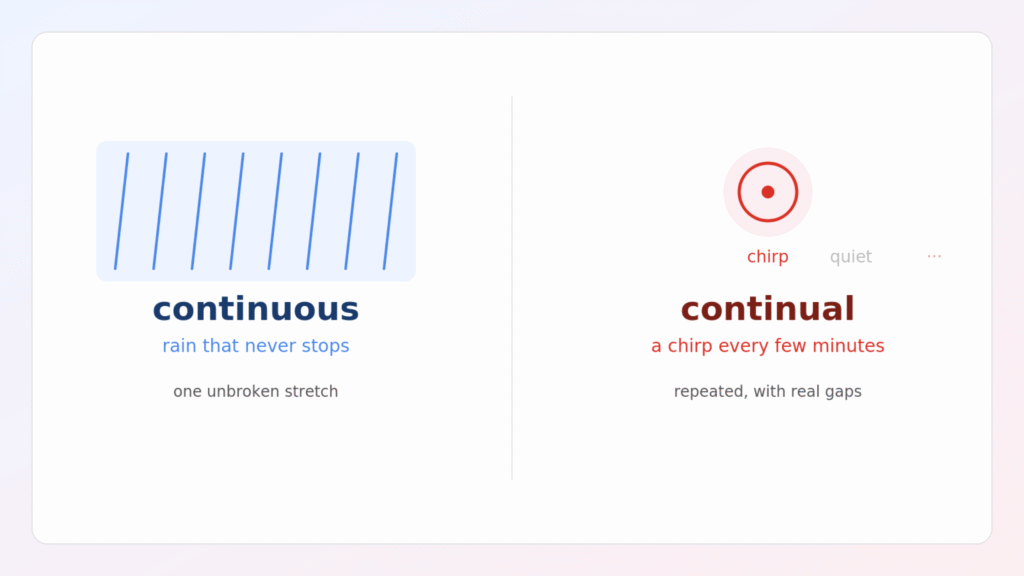
This distinction carries more weight than it looks, especially anywhere precision matters — a maintenance log, a medical chart, a legal document. Writing that a generator ran “continuously” for eight hours tells a completely different story than writing that it ran “continually.” One means it never shut off. The other suggests repeated operation, which may include pauses or interruptions. That difference can matter when someone needs an accurate record.
The distinction isn’t always that strict, though. “Continual” often describes repeated events with pauses, but writers sometimes use it for something that continues over a period. Context matters, so avoid treating the two words as exact opposites in every sentence.
Worth noting while we’re here: “continuous” is an adjective, and its adverb form is “continuously.” “Continual” pairs with “continually.” Neither of these has any connection to “continous” — that spelling doesn’t exist as a noun, verb, adjective, or anything else. And the same mistake shows up almost as often in its adverb form: “continously,” which is just as wrong as “continous” and for the same reason.
For example, “The machine ran continuously for six hours” means it did not stop during that period. “The machine needed continual repairs” means repairs were needed repeatedly. The surrounding words help make the intended meaning clear.
See Also: Is It Congradulations or Congratulations? Get the T Right
Where this typo slips past spell-check
Most writing software flags “continous” the instant you type it — a squiggly red line shows up, you fix it, and you never think about it again. The problem is the handful of places that don’t run a spell-checker automatically.
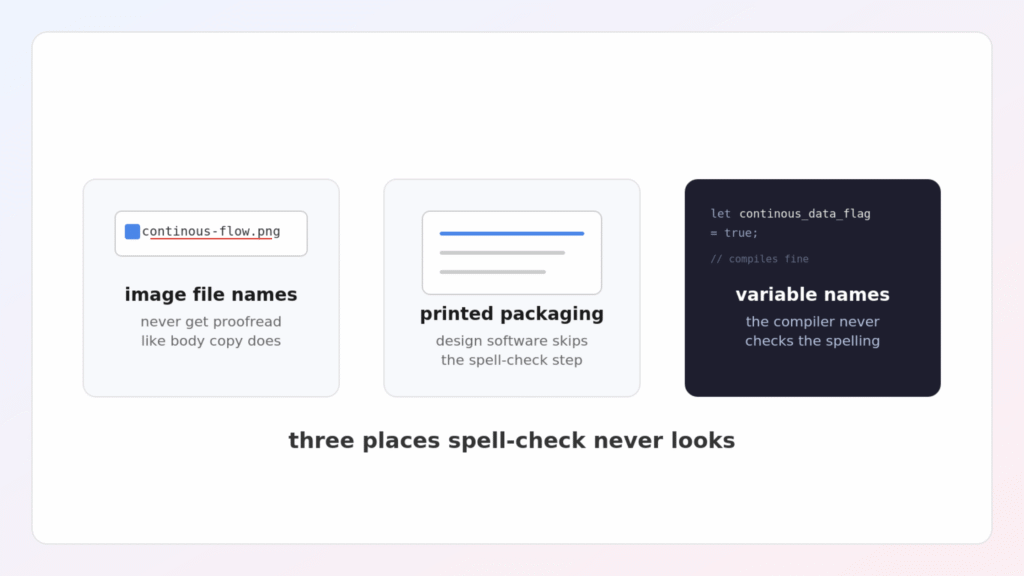
Image file names and alt text rarely get proofread with the same attention as body copy, so a file saved as “continous-flow-diagram.png” can sit live on a website for years before anyone notices. Printed packaging and signage go through design software that doesn’t always run English spell-check the way a word processor does, so an error can go to print before a human catches it. And in code, a variable named continous_data_flag will compile and run without a single complaint from the compiler — the mistake only becomes visible to the next developer who has to read it.
None of these spots get caught by the tools most people rely on by default, which is exactly why this typo survives even in otherwise careful writing.
The same problem can affect image captions, page descriptions, and text copied into a design file. A spell-checker may catch a mistake in the main article but miss it elsewhere. Before publishing, look over captions, alt text, and page descriptions too, particularly any that include “continuous.”
The two-second check before you hit publish
Skip the grammar-checker subscription for this one — this isn’t a word whose correctness depends on context. It’s simply wrong, every time, in every sentence. If it appears anywhere in your draft, remove it.
So before you send or publish anything, run a quick search for “continous” in the document. Zero results means you’re clear. One result means you fix it — and it’s worth glancing at the sentence around it too, since a typo like this one rarely travels alone.
Next time you’re mid-sentence and typing faster than you’re thinking, slow down right at that word. Type the u, then the o, then the u again. Three vowels in a row, and every one of them is doing something — leave one out and the whole word falls apart.
This search also works for longer documents. Use Ctrl+F on Windows or Cmd+F on a Mac, enter “continous,” and review each result. Check “continously” separately if you want to catch the related adverb misspelling too.
FAQs
Is “continous” a word?
No. “Continous” is a misspelling of “continuous.” It isn’t an accepted spelling variant.
How do you spell continuous?
The correct spelling is C-O-N-T-I-N-U-O-U-S. It has ten letters. You can remember it as con-tin-uous or check the three-vowel sequence at the end: u-o-u.
What’s the difference between continuous and continual?
“Continuous” usually means without interruption. “Continual” usually means happening repeatedly, often with pauses between occurrences. Which word fits depends on the sentence, and in some cases both work.
Final verdict
Use “continuous.” “Continous” is always wrong. Count to ten letters, or check for the u-o-u ending, before you hit publish.
See Also: 22th or 22nd: Which Spelling Is Correct?

[…] by a language that doesn’t always cooperate. It’s the same instinct behind writing continous instead of continuous, where an unstressed syllable just gets swallowed and dropped. Gnaw is one of the clearer examples, […]