

If you’ve ever paused mid-sentence wondering whether to type “liar and lier” or just “liar,” you’re not alone — and the fix is quicker than the doubt. Almost every time, you want liar. “Lier” exists, technically, but it means something so different (and so rarely used) that reaching for it by accident can make a sentence say the opposite of what you meant.
Liar: the word you’re almost certainly after
A liar is someone who says things they know aren’t true. That’s it — no extra conditions, no softening. “My coworker told the manager she finished the report, but she’s a liar; she hadn’t even opened the file.” Notice the article before it: “a liar,” not just “liar.” Skipping that word is one of the most common slips among learners, because plenty of languages don’t require an article in front of a noun describing what someone is.
Pronunciation trips people up too. Say it as two syllables, LIE-er, stress on the first part. It looks close to “lawyer” on the page, and a few learners genuinely mix the two up in speech — which gets awkward fast, since accusing your accountant of being a lawyer isn’t the insult you meant.
Quick reference
| Liar | Lier | |
| Meaning | Person who tells untruths | Person/thing lying down |
| Frequency | Common, everyday word | Rare, mostly dictionary-only |
| Root verb | lie (lied, lied) | lie (lay, lain) |
| Safe default | Yes — use this one | No, unless you specifically mean reclining |
Lier: real, but almost a ghost
A lier is a person or thing lying down — resting horizontally, or crouched somewhere waiting. Think of a hunter positioned behind a bush, staying still until the right moment. That’s a lier, technically. You’ll find the word in a dictionary. You’ll rarely find it in a sentence written after, say, 1950. If you’ve typed “lier” recently, there’s a strong chance your fingers meant “liar” and just missed.
One verb, two completely different jobs
Here’s where the mix-up actually starts, and it’s not really about spelling — it’s about the verb underneath both words. English has a verb lie that means “to say something false” (lie, lied, lied), and a separate verb lie that means “to recline” (lie, lay, lain). Same spelling, same sound, unrelated meanings. Add -er to the first one, and English shifted the spelling to -ar, giving you liar. Add -er to the second, and it stayed lier. Two verbs that happen to look identical produced two nouns that look nearly identical. That’s the whole confusion, in one sentence — not a random spelling quirk, but a genuine fork in the language.
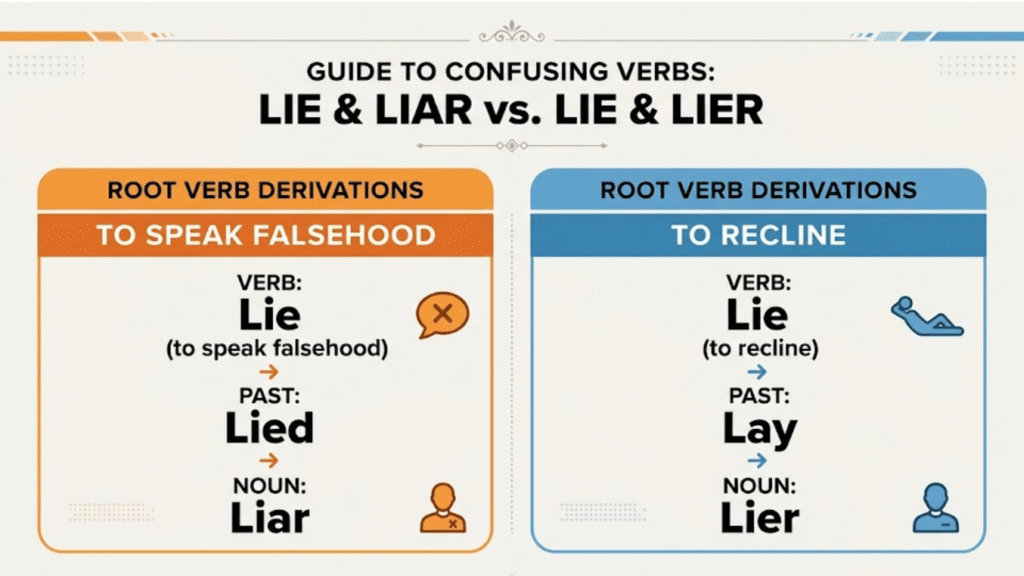
Why -ar and not -er
This part actually has a pattern, and once you see it, “liar” stops being something you have to memorize by brute force. A handful of English agent nouns — words for “a person who does X” — take -ar instead of the usual -er: beggar, burglar, scholar. Liar joined that small club centuries ago. No rule predicts exactly which words land in it; you mostly learn them by exposure. But knowing the club exists means “liar” isn’t an exception floating alone — it has company, and that makes it easier to remember.
The mistakes that actually show up in writing
Three patterns come up again and again, and none of them are really about spelling:
- Dropping the article — writing “He is liar” instead of “He is a liar.” English almost always requires that little word before a singular countable noun describing a role or category, and “liar” falls squarely into that category.
- Confusing the noun with the verb’s other form — writing “she told a liar” when the sentence needs “lie.” A liar is the person; a lie is the statement itself — the thing that isn’t true. One student I worked with kept writing “don’t say liars to me,” meaning “don’t lie to me” — an understandable slip, since the two words share almost every letter.
- Letting autocorrect substitute the wrong word — some spell-checkers don’t flag “lier” because it’s a legitimate dictionary word, so it slides through even when “liar” was intended. Worth a manual re-read if your writing tool has ever quietly “fixed” something for you.
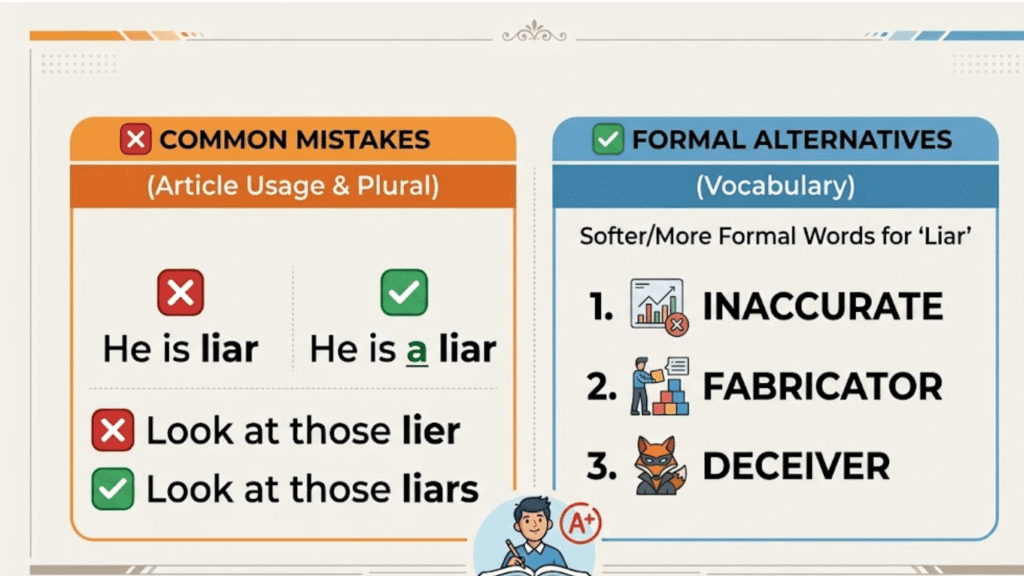
How to use it correctly — some examples
- “The witness changed her account three times before the jury stopped believing anything she said.”
- “The witness changed her account three times before the jury stopped believing anything she said.”
- “She’s not usually a liar, but she clearly stretched the truth about why she was late.”
Each of these keeps the article (“a liar”) and treats it strictly as a noun for a person — never as a description of the false statement itself.
Softer words for formal writing
“Liar” is blunt. In a job application, a performance review, or a client email, that bluntness can read as unprofessional even when it’s accurate. A few workable alternatives, depending on how direct you need to be:
- “The figures weren’t accurate.”
- “The account wasn’t consistent with the facts.”
- “He wasn’t forthcoming about the timeline.”
None of these call someone a liar outright, but they get the point across in writing you’d actually send to a supervisor. If you do need a single word rather than a phrase, options include deceiver (more formal, broader than spoken lies alone), fabricator (suggests inventing a whole story rather than a small untruth), and fibber (informal, almost childish — fine for casual conversation, wrong for a report).
See Also: Propose vs Purpose: The Word History Nobody Tells You
A phrase or two worth knowing
Call someone a pathological liar and you mean they lie compulsively, often for no clear reason — common in everyday speech, not just clinical talk. “Liar, liar, pants on fire” started as a playground taunt and stuck around into adult use, usually said half-joking. Both are useful to recognize even if you never use them yourself; they show up constantly in casual English media.
The one line worth remembering
When you’re unsure which to type, ask what the sentence is actually about. Dishonesty, almost always, means liar. Someone physically reclining or crouched somewhere — a case you’ll run into maybe once a year — means lier. Given how lopsided that split is, treating “liar” as your default and “lier” as the rare exception will be right nearly every time you write.
FAQ
Is “lier” actually a word, or is it always a typo?
It’s a real word — dictionaries do list it. But in practice, almost nobody uses it on purpose anymore. If you’re not specifically talking about someone lying down or lying in wait, you typed the wrong one.
What’s the plural of liar?
Liars. Regular plural, no spelling changes. The two liars gave matching stories until the lawyer asked for exact dates.
Is “liar” rude to say to someone?
Yes, generally. It’s a direct accusation, not a neutral description. Fine in casual arguments or informal writing, but you’d want a softer phrase (“that’s not accurate,” “the story doesn’t add up”) in professional or academic contexts.
What’s the difference between “liar” and “lie”?
A liar is the person. A lie is the statement itself — the thing that isn’t true. “He told a lie” is correct; “he told a liar” isn’t — unless he literally told something to a liar.
Why does “liar” end in -ar instead of -er like most similar words?
It’s part of a small group of English agent nouns that took the -ar ending — beggar, burglar, and scholar work the same way. No strict rule explains why these particular words ended up there; it’s a pattern you absorb rather than derive.
Can “lier” ever be correct in modern writing?
Rarely, but yes — mostly in older texts, hunting or military contexts (“lying in wait”), or very literal descriptions of someone’s physical position. For everyday writing, treat “liar” as the safe default.
See Also: Knaw or Gnaw — Which One Is Actually Correct?

[…] cutoff flips a village into a town, or a town into a city. The line moves depending on the country, sometimes the region, sometimes just local habit. In casual conversation, these three words are a rough […]