

You’ve probably typed “mine as well” at some point without thinking twice about it. Maybe you caught it, maybe you didn’t. The question of mine as well or might as well trips up more writers than you’d expect, and the mix-up isn’t really about carelessness — it’s about how English sounds when people actually talk.
Here’s the short version: “might as well” is correct almost every time. “Mine as well” is usually what happens when your ear catches something your brain then spells wrong. And there’s a third phrase hiding in this mess — “mind as well” — that adds its own layer of confusion. Let’s take them one at a time, because they’re doing three different jobs, not two.
The quick answer, if that’s all you need
Might as well is the idiom. Use it any time you’re suggesting an action makes sense given the circumstances, even a mildly unwelcome one — waiting out a delay, finishing a task you’d rather put off, agreeing to plans you’re lukewarm about.
Mine as well works in exactly one narrow situation: when “mine” is a possessive standing in for something of yours, and “as well” just means “also.” That’s a much rarer sentence than people assume, and we’ll get to a real example of it shortly.
Mind as well shows up occasionally, almost always meaning the same thing as “might as well,” but it isn’t standard, and it will read as an error in most writing.
If you’re staring at a sentence and unsure which one fits, ask yourself one thing: are you suggesting an action, or are you claiming something belongs to you? Nine times out of ten, you’re suggesting an action. Write “might as well.”
What “might as well” is actually doing in a sentence

People describe “might as well” as meaning “there’s no reason not to,” and that’s a fine starting point, but it undersells the phrase’s emotional flavor. It’s not neutral. There’s a shrug built into it — a sense that you’re doing something not because you’re excited about it, but because the alternative isn’t any better and might be worse.
Say a coworker cancels a meeting fifteen minutes before it’s supposed to start, after you’ve already walked to the conference room. You might as well sit down and answer emails instead of walking back. Nobody’s thrilled. Nothing’s ideal. It’s just the sensible move given where you already are.
That’s sense one, and it’s the one you’ll use constantly: recommending or accepting an action because it costs nothing. But this phrase does a second job, one that gets skipped over more often than it should.
Sense two: looking backward at something that already happened and judging that it changed nothing. “The presentation ran forty minutes over and covered none of the material we needed — we might as well have skipped it.” Nobody’s suggesting an action here. The meeting’s already over. This version works more like a complaint dressed up as logic: whatever we’d done instead would have landed us in the same place.
Keeping these two uses separate matters, because they run on different grammar. The first takes a plain base verb — might as well go, might as well ask, might as well stay. The second needs the perfect construction: might as well have gone, might as well have asked, might as well have stayed. Mixing them up (“we might as well have leave early” — not right) is a rarer mistake than confusing “might” with “mine,” but it happens, especially when a writer has internalized the first sense and reaches for the second without adjusting the verb form.
The grammar mechanics worth knowing
“Might” is a modal verb, and modals come with a short list of rules that don’t bend. No “to” after them — you write “might as well go,” never “might as well to go.” No conjugation for person or number either; “she might as well go” uses the same form as “I might as well go” or “they might as well go.” Modals don’t care who the subject is.
Negatives place the “not” right after “well,” not after “might”: “I might as well not bother calling him back — he never picks up anyway.” That sentence is doing something slightly different from a plain negative statement. It’s saying that bothering wouldn’t change anything, so skipping it costs nothing either.
Questions with this idiom are rare in real speech — mostly you’ll hear it as a reply rather than as a question someone actually asks. “Should we head out now?” “Might as well.” Short, clipped, standing on its own without even a subject attached. That’s completely normal in conversation and shows up plenty in dialogue writing, even though stripped of context it would look incomplete on the page.
Why your brain hears “mine” instead of “might”
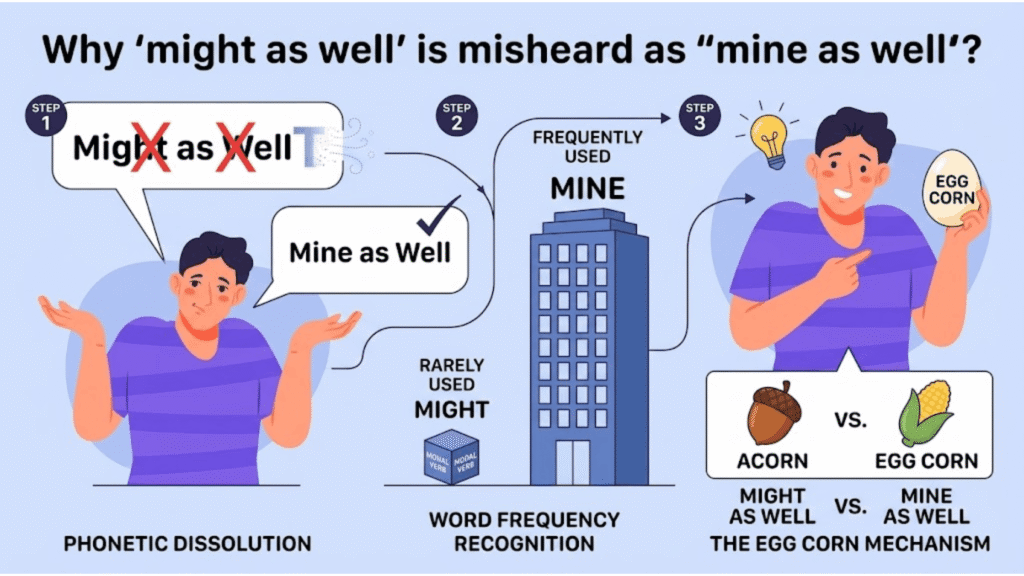
This is the part most explanations of this topic gesture at without really digging in, so let’s actually sit with it.
Say “might as well” out loud at a normal conversational speed — not slowly, not carefully, how you’d say it to a friend. Notice what happens to the T in “might.” It softens, and in a lot of accents it disappears almost entirely, especially with a vowel sound coming right after it, which “as” happens to supply. What’s left lands somewhere close to “mine as well” for a listener who doesn’t already have the spelling locked in.
And “mine” is a word people already know cold. It’s short, common, and doing real work in plenty of other sentences. “Might,” by contrast, barely shows up outside this one construction. So when the ear catches an ambiguous sound, the brain reaches for the word it recognizes rather than the modal it rarely uses anywhere else.
There’s a name for this kind of substitution, and it’s more precise than just calling it a typo. Linguists call it an eggcorn — a term coined in 2003 by Geoffrey Pullum on the linguistics blog Language Log, after a contributor noticed someone had written “egg corns” instead of “acorns.” What separates an eggcorn from a random spelling slip is that the new version still makes a kind of sense on its own terms. An acorn is roughly egg-shaped, if you squint. “Mine as well” parses as a real sentence too — it’s not gibberish; it’s just answering a different question than the one the writer meant to ask.
Which is exactly why this particular slip refuses to go away. If “mine as well” were nonsense, it would get flagged every time, and nobody would ever publish it by accident. But it’s a genuine grammatical construction, just usually not the one the writer intended.
The one place “mine as well” actually belongs.s
Here’s where I’ll push back a little on the idea that “mine as well” is simply wrong. It isn’t — it’s just narrow.
“Mine” is a possessive pronoun. It stands in for “my [noun]” once the noun’s already been established. “That’s my umbrella” becomes “That’s mine.” Add “as well,” meaning “also” or “too,” and you get a legitimate sentence.
Picture two coworkers comparing notes after a rough week. One says, “My review got pushed to next quarter.” The other replies, “Mine as well — I think they’re behind on all of them.” Nothing to fix there. It’s correct as written.
But notice something: even in that correct example, most people would say “so did mine” or “mine got pushed too” instead. “Mine as well” is grammatically sound but stylistically a little stiff, almost formal in a way that doesn’t match how the rest of the sentence sounds. That stiffness is part of what makes the eggcorn so easy to fall into — the correct possessive use is rare enough in everyday writing that most people have never actually needed it, so when “mine as well” turns up, it’s overwhelmingly the mistake, not the exception.
See Also: City vs Town vs Village: 3 Real Differences That Matter
“Mind as well” — the quieter mix-up
There’s a third phrase in this family that gets less attention: “mind as well.” You’ll run across it in comment sections, in transcribed speech, occasionally in dialogue written to capture a particular voice.
“Mind” as a verb usually means to care about something or attend to it — “mind the gap,” “I don’t mind waiting.” Slot that meaning into “mind as well” and it falls apart; “I mind as well leave” doesn’t parse as “I care about leaving too” in any sensible way. So functionally, when people write “mind as well,” they clearly mean “might as well” — it’s just drifted from the original through the same kind of mishearing.
Worth being careful here: a few sources describe “mind as well” as a specific regional or dialectal form, and I can’t verify that with any confidence. It might be true in certain speech communities. It might just be an individual mishearing that keeps cropping up independently — the same pattern behind “for all intents and purposes” becoming “for all intensive purposes,” which isn’t tied to any particular region either. Treat “mind as well” as a nonstandard variant worth avoiding in writing, not a documented dialect feature you can cite with authority.
If a character’s voice in a piece of fiction calls for it, that’s a legitimate creative choice — dialect and informal speech belong in dialogue. Outside of that, “mind as well” will read as an error, not a stylistic one.
This isn’t a solo problem — English does this constantly
Once you notice the might/mine mix-up, it’s worth zooming out, because this same pattern — a phrase reshaped because it sounds like something more familiar — shows up all over English, and recognizing the pattern makes you faster at catching it in your own writing.
“Could have” turns into “could of” for the same reason “might as well” turns into “mine as well”: the contracted spoken form (“could’ve”) sounds almost identical to “could of,” and most people know exactly how to spell “of” — it’s “could’ve” that nobody bothers spelling out. Same mechanism, different phrase. “Supposed to” loses its D in casual speech often enough that people write “suppose to.” “Free rein” — a term from horseback riding, giving a horse loose control of its own direction — gets rewritten as “free reign,” because far more people know what a king’s reign is than have ever held a set of reins.
And “might as well” itself has more than one misheard cousin. Beyond “mine as well,” you’ll occasionally find “minus well,” where the compressed pronunciation lands closer to “minus” than either “mine” or “might.” It’s rarer than “mine as well,” but it turns up often enough in collected lists of these mishearings that it’s clearly not a one-off.
None of this reflects careless thinking. It reflects the fact that English spelling and English pronunciation drifted apart centuries ago, and every fluent speaker is constantly translating on the fly between what they hear and what they’re supposed to write. Most of the time that translation holds up. Sometimes it produces an eggcorn instead.
Don’t confuse this with “may well,” a different phrase entirely
One more phrase sits close enough to cause trouble, though for a different reason than mishearing — this one’s about how similar the words look on the page. “May well” and “may as well” are not the same thing, even though they share two of three words.
“May well” expresses likelihood. “The delay may well cost us the contract” means it’s genuinely probable that it will —a prediction, not a suggestion. Swap in “may as well,” and the meaning shifts entirely: “The delay may as well cost us the contract” reads more like resigned acceptance that the damage is already done, which isn’t usually what someone means when they reach for this phrase.
Worth noting: “may as well” and “might as well” function as the same idiom — Merriam-Webster lists them together in one entry. Some writers treat “might as well” as slightly more casual and “may as well” as marginally more formal, but that distinction is soft at best, closer to personal ear than an actual rule, so don’t lean on it too hard.
Seeing it in context
Grammar rules land better against real scenarios than a stack of interchangeable example sentences, so here are a few, each doing something different.
You’re texting a friend about weekend plans, and they’ve just told you they’re stuck at work until 8. You write back: “Might as well push dinner to 8:30 then, no point rushing.” That’s the classic use — practical, low-stakes, resigned but not bitter.
In a work context, picture a budget proposal that’s already been rejected twice. Someone on the team says, “We might as well rewrite the whole thing instead of patching it again — the third version’s going to get the same objections.” That’s the idiom carrying real argumentative weight, not just casual acceptance. It’s persuasive: why bother with a small fix when the real problem needs a bigger one.
Here’s a trickier one, the kind of sentence where a reader might genuinely pause: “After the delay, missing the connection or catching it barely mattered — we might as well have flown standby the whole way.” Read it once, and it could almost pass for a suggestion about the future. It isn’t. It’s the retrospective sense — judging that catching the flight and missing it turned out equally bad, so the scramble to make the connection accomplished nothing.
Catching this in your own drafts
A find-and-replace pass for “mine as well” will catch a real chunk of mistakes, but it’s a blunt tool. It won’t flag “mind as well,” and it can’t tell you when “mine as well” is one of the rare cases where it’s actually correct — you’ll still need to read each hit and ask what the sentence is doing.
The fastest test is the one from the top of this piece: are you suggesting an action, or claiming ownership? If “also” or “too” can replace “as well” without changing the meaning, you’re in possessive territory, and “mine as well” (or a smoother rewrite of it) is probably right. If you’re recommending or explaining a course of action, it’s “might as well” — no exceptions worth memorizing beyond that.
When you’re unsure and don’t have time to work it out, default to “might as well.” It’s correct in the vast majority of real sentences, and the possessive use is rare enough that betting on it will serve you far better than betting against it.
One more thing worth remembering
The next time you catch yourself typing “mine as well,” it’s worth pausing on why it happened — not because you don’t know the difference between possession and suggestion, but because “might as well” barely survives being spoken out loud. The T disappears, the words blur together, and your fingers just typed what your ear actually caught. That’s not a grammar failure. That’s just what happens when a language gets spoken billions of times faster than it ever gets spelled out.

[…] See Also: Mine as Well or Might as Well: The Real Reason You Mix Them Up […]