

Understanding City vs Town vs Village: A city is bigger and more urban. A town is smaller. A village is smaller still. That’s the simple version, and it works well at a dinner party. Try to pin it down with exact rules, though, and it falls apart fast.
No global population cutoff flips a village into a town, or a town into a city. The line moves depending on the country, sometimes the region, sometimes just local habit. In casual conversation, these three words are a rough sketch—giving you a sense of scale and feel. In legal documents, they can mean something much more specific, and that specific meaning changes by jurisdiction.
The basic scale: City vs Town vs Village
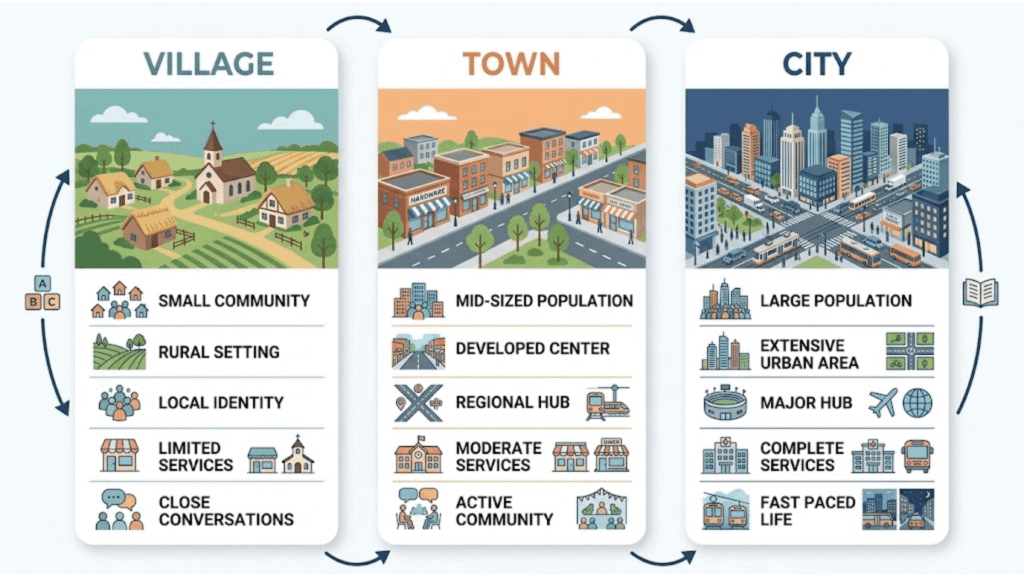
Picture them on a line: village, then town, then city.
A city is a large urban area — lots of neighborhoods, a mix of housing and business districts, enough infrastructure to support hundreds of thousands of people or more. A town sits in the middle. Think of a Main Street, a school or two, maybe a hardware store and a diner that’s been open since the 1970s — big enough to serve the surrounding area but not sprawling. A village is smaller, yet usually with a rural feel, though that doesn’t mean it’s cut off from the world. Plenty of villages have a shop, a pub, a church.
None of this is a strict rulebook. It’s closer to a shared instinct that most English speakers already carry around.
Why population numbers don’t settle it
You’ll sometimes see tidy formulas floating around online — something like: village under 1,000 people, town from 1,000 to 100,000, city above that. Skip those. They’re not real English-language rules, and treating them as gospel will trip you up.
Population tells you something about scale, sure. It doesn’t decide what gets printed on the road sign. The U.S. Census Bureau is upfront about this: legal designations for incorporated places — city, town, village, borough — vary from state to state, and the powers attached to each label vary right along with them. A town in Massachusetts and a town in Texas can mean genuinely different things administratively, even if both places have roughly the same number of residents.
So here’s the more useful way to think about it: population describes size. It doesn’t determine the official name. For everyday writing, you rarely need a census figure before reaching for one of these three words.
City vs. town
The gap here is mostly about scale and density.
Say someone tells you, “I grew up in a town where the nearest movie theater was 40 minutes away.” You picture something compact — homes, a school, a few shops, maybe one traffic light. Busy enough during the day, quiet enough at night that you’d know your neighbors’ dogs by name.
Now compare that to “I live in the city.” Different picture entirely — more neighborhoods, denser traffic, more going on at 11 p.m. on a Tuesday.
That’s the usual split, but real places rarely fit neatly into one category. Plenty of towns have a genuinely busy commercial strip and apartment blocks. Plenty of cities have quiet, tree-lined residential streets that feel nothing like downtown. The label describes the whole place in broad strokes — not every block inside it.
Town vs. village
This is the fuzzier boundary, honestly.
A village can have a grocery store, a school, a café, a bus stop, and be near the nearest town. None of that automatically makes it a town. What tends to matter more is the overall impression — size, how built-up it feels, whether people from outside come there to shop or just pass through.
Take my neighbor’s line — “she’s out in a village, past the last farm before it turns to hills.” That’s one image right there. “My cousin lives in a town where three villages send their kids to the same high school” paints a different one — a place that functions as a hub for a wider area, not just a home for its own residents.
Two places with nearly identical populations can end up with different labels purely because of local tradition or how the paperwork got filed a century ago. English was just never designed to be that precise.
City vs. village
This one’s the easy comparison. A city implies real urban weight — offices, transit, a skyline, some version of rush hour. A village implies the opposite: small, usually rural, often surrounded by open land.
“She spent her childhood in a village an hour past the last train stop” tells you everything you need without a single statistic attached. Small settlement, nearest city a real trip away. That’s the whole job these words do in ordinary speech — paint a quick picture, not hand over exact measurements.
See Also: Propose vs Purpose: The Word History Nobody Tells You
How the words show up beyond geography
These terms carry extra weight in everyday phrasing too.
“City” often stands in for one specific place everyone in the conversation already has in mind — “she moved to the city after graduating” doesn’t need a name attached. British English does something similar with “town.” Saying “I’m going into town” usually doesn’t mean leaving for a different town altogether — it means heading to the local center, the shops, wherever the action is. The Cambridge Dictionary lists this use directly.
“Village” tends to stay literal. “The village hall is being repainted this month” — it’s talking about the settlement itself, not a stand-in phrase for anything bigger.
The rules change country by country.
Everyday usage travels reasonably well across English-speaking countries. Legal status is another matter entirely.
UK city status. Here’s where it gets genuinely interesting. A British town doesn’t earn city status by hitting a population mark — there isn’t one. The Crown grants it through Letters Patent. In the 1540s, Henry VIII granted city status to six towns alongside newly created cathedrals, which is where the cathedral-city assumption comes from. It stuck around for centuries, but it hasn’t been a requirement since the late 1800s — Birmingham became a city in 1889 without one. Ely still holds city status today with a population under 20,000, smaller than plenty of towns that will never carry the title. If you assume a cathedral is the deciding factor, you’re using outdated logic.
US classifications. No nationwide population range decides what counts as a city, town, or village. It comes down to state law. The Census Bureau groups cities, towns, villages, and boroughs together under “incorporated places,” but what each one legally means — governing powers, tax authority, all of it — shifts depending on the state you’re standing in.
Village vs. countryside — not the same thing
A village is a settlement. The countryside is generally rural land, whether or not there’s a cluster of houses.
Say “they’ve settled in a village ringed by wheat fields” versus “they’ve moved out to the countryside” — those two sentences aren’t doing the same job. The first names a specific kind of place. The second just tells you it’s rural — could be a farmhouse standing alone, could be a handful of homes too scattered to count as a proper village. Worth keeping straight, especially if you’re translating from a language where the distinction blurs.
Where people trip up
Treating population thresholds as universal is the big one — those numbers, if they apply at all, belong to one country’s specific legal system, not to English generally.
Another common slip: figuring a town big enough must count as a city in the eyes of the law. Size and status don’t always line up, especially in places like the UK where history plays as large a role as headcount.
Then there’s the cathedral myth — still floating around despite being over a century out of date.
People also underestimate villages, picturing them as bare crossroads with nothing but a single farmhouse. Plenty have shops, schools, even a small clinic. And villages get conflated with “the countryside” more often than they should, even though one is a settlement and the other is just land.
One more: don’t rename a place based on your own sense of its size. If it’s officially a town, it stays a town regardless of how big it feels walking through it.
Which word should you reach for?
For casual writing, go with instinct. Large and urban — city. Smaller, with its own local center — town. Small and rural — village. You don’t need a census figure on hand every time.
If you’re writing something official — government documents, geographic data, anything about a specific named place — check the actual classification rather than trusting the general feel of the word. That’s the one place where guessing gets you into trouble.
Quick reference
| Word | General meaning | Typical impression |
| City | Large urban settlement | Extensive, densely built |
| Town | Mid-sized, developed center | Smaller hub with local services |
| Village | Small settlement, often rural | Compact, fewer buildings |
These reflect general usage, not legal definitions anywhere specific.
Frequently asked questions
Is a town bigger than a village?
Usually, that’s the standard assumption in everyday English, though official designations can differ by country.
Does city status always mean bigger than a town?
Not necessarily by law, even if it usually holds in casual speech. Legal status doesn’t always track size.
Can a village become a town?
Yes—through local reclassification or gradual growth over time, depending on the system in place.
Can a town become a city?
Yes, though there’s no single global process. In the UK, it takes a formal grant, not an automatic population trigger.
Does population decide city status?
Not universally. It can matter, but the actual rule depends on the country and sometimes the state.
Does a city need a cathedral?
No — hasn’t been required in the UK since the 19th century.
Does “village” just mean “countryside”?
No. A village is a settlement; the countryside is the surrounding rural land.
A city is generally bigger than a town, and a town generally bigger than a village — that’s the everyday rule of thumb, and it’ll serve you fine in casual writing. Step into official geography or government documents, though, and local law takes over from there.
See Also: Knaw or Gnaw — Which One Is Actually Correct?

[…] See Also: City vs Town vs Village: 3 Real Differences That Matter […]